Thursday, July 9, 2026
spot_img
Home Blog Page 61

Stretchable, Flexible, Recyclable – This Plastic Is Fantastic

0

Stretchable, Flexible, Recyclable – This Plastic Is Fantastic

Princeton engineers have developed an easily scalable 3D printing technique to manufacture soft plastics with programmed stretchiness and flexibility that are also recyclable and inexpensive – qualities not typically combined in commercially manufactured materials.

In an article in the journal Advanced Functional Materials, a team led by Emily Davidson reported that they used a class of widely available polymers called thermoplastic elastomers to create soft 3D printed structures with tunable stiffness. Engineers can design the print path used by the 3D printer to program the plastic’s physical properties so that a device can stretch and flex repeatedly in one direction while remaining rigid in another. Davidson, an assistant professor of chemical and biological engineering, said this approach to engineering soft architected materials could have many uses, such as soft robots, medical devices and prosthetics, strong lightweight helmets, and custom high-performance shoe soles.

Sameer A. Khan/Fotobuddy | princeton.edu By controlling the material’s internal structure, engineers can create objects with a range of properties.

The key to the material’s performance is its internal structure at the tiniest level. The research team used a type of block copolymer which forms stiff cylindrical structures that are 5-7 nanometers thick (for comparison, human hair measures about 90,000 nanometers) inside a stretchy polymer matrix. The researchers used 3D printing to orient these nanoscale cylinders, which leads to a 3D printed material that is hard in one direction but soft and stretchy in nearly all others. Designers can orient these cylinders in different directions throughout a single object, leading to soft architectures which exhibit stiffness and stretchiness in different regions of an object.

“The elastomer we are using forms nanostructures that we are able to control,” Davidson said. This allows designers a great degree of control over finished products. “We can create materials that have tailored properties in different directions.”

The first step in developing this process was choosing the right polymer. The researchers chose a thermoplastic elastomer, which is a block copolymer that can be heated and processed as a polymer melt, but which solidifies into an elastic material when it cools. At the molecular level, polymers are long chains of linked molecules. Traditional homopolymers are long chains of one repeating molecule, whereas block copolymers are made of different homopolymers connected to each other. These different regions of a block copolymer chain are like oil and water- they separate instead of mixing. The researchers used this property to produce material with stiff cylinders within a stretchy matrix.

The researchers used their knowledge of how these block copolymer nanostructures form and how they respond to flow to develop a 3D printing technique that effectively induces alignment of these stiff nanostructures. The researchers analyzed the way that printing rate and controlled under-extrusion could be used to control the physical properties of the printed material.

Alice Fergerson, a graduate student at Princeton and the article’s lead author, spoke about the technique and the key role played by thermal annealing – the controlled heating and cooling of a material.

“I think one of the coolest parts of this technique is the many roles that thermal annealing plays – it both drastically improves the properties after printing, and it allows the things we print to be reusable many times and even self-heal if the item gets damaged or broken.”

Davidson said that one of the goals of the project was to create soft materials with locally tunable mechanical properties in a way that is both affordable and scalable for industry. It is possible to create similar structures with locally controlled properties using materials such as liquid crystal elastomers. But Davidson said those materials are both expensive (upwards of 2.50 per gram) and require multi-stage processing involving carefully controlled extrusion followed by exposure to ultraviolet light. The thermoplastic elastomers used in Davidson’s lab cost about a cent per gram and can be printed with a commercial 3D printer.

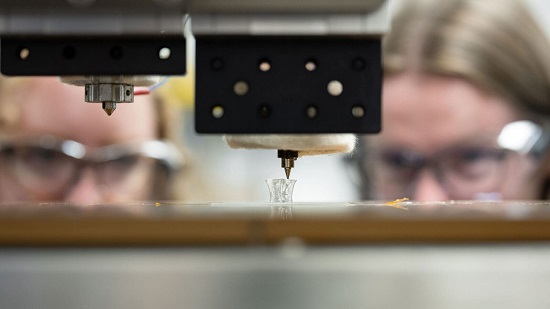
The researchers have shown their technique’s ability to incorporate functional additives into the thermoplastic elastomer without reducing the ability to control material properties. In one example, they added an organic molecule developed by Professor Lynn Loo’s group that makes the plastic glow red after exposure to ultraviolet light. They also demonstrated the printer’s ability to produce complex and multi-layered structures including a tiny plastic vase and printed text that used sharp turns to spell out PRINCETON.

Annealing plays a key role in their process by increasing the perfection of the order of internal nanostructures. Davidson said annealing also enables self-healing properties of the material. As part of the work, the researchers can cut a flexible sample of the printed plastic and reattached it by annealing the material. The repaired material demonstrated the same characteristics as the original sample. The researchers said they observed “no significant differences” between the original and the repaired material.

As a next step, the research team expects to being exploring new 3D printable architectures that will be compatible with applications such as wearable electronics and biomedical devices.

The article, Reprocessable and Mechanically Tailored Soft Architectures Through 3D Printing of Elastomeric Block Copolymers, was published Sept. 24 in the journal Advanced Functional Materials. Besides Davidson and Fergerson, authors include Benjamin H. Gorse ’24, Shawn M. Maguire, postdoctoral researcher, and Emily C. Ostermann, a graduate student in chemical and biological engineering. Support for the project was provided in part by the National Science Foundation through Princeton PCCM SEED funds from the Princeton Center for Complex Materials, and Princeton Project X Innovation Funds.

https://www.todaysmedicaldevelopments.com

#3DPrinting #todaysmedicaldevelopments #RecyclablePlastics #ThermoplasticElastomers #SoftRobotics#SustainableMaterials#BiomedicalInnovation#AdvancedMaterials #PrincetonEngineering#modernplasticsindia#modernplasticsasia #plasticsislife  #plasticstalk  #modernplastics#pasticsnews #plasticsisgood #plasticsplane #plasticsrecycling#plasticmagazine  #plasticIndustry#modernplasticsmiddleeast #indianmagazine#innovations #modernplasticsamerica #modernplasticsbangladesh #modernplasticsasia#modernplasticsitaly

Afroplast Exhibition to Showcase Plastics Industry Technologies in Cairo

0

Afroplast Exhibition to Showcase Plastics Industry Technologies in Cairo

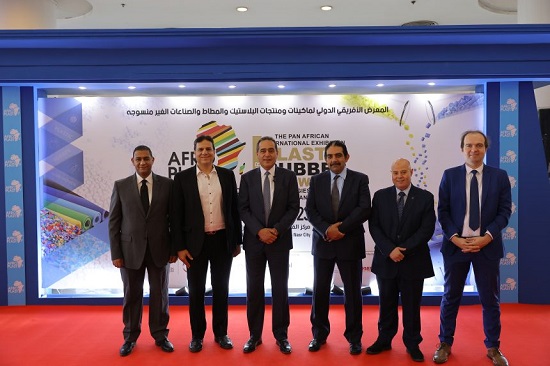
The “Afroplast” exhibition, an international trade fair for the plastics, rubber, and non-woven industries, will take place from 16 to 19 January 2025, at the Cairo International Conference and Exhibition Center in Nasr City. The event is under the patronage of the Ministry of Industry, the Ministry of Investment and Foreign Trade, and the Chemical and Fertilizers Export Council, with backing from the Chemical Industries Chamber of the Federation of Egyptian Industries.

The exhibition is expected to host over 300 exhibitors from 15 Arab and international countries. It will showcase a range of raw materials, intermediate goods, finished products, machinery, technologies and solutions for the plastics, rubber, and elastomer sectors.

A dedicated pavilion featuring multi-use plastic products will host approximately 30 exhibitors, with the aim of displaying the latest innovations and securing export contracts with international buyers.

The event will also include conferences and panel discussions led by industry experts, exporters, and government officials, focusing on topics such as local industry development, market expansion in Africa, the Arab world, and Europe, and adherence to international standards.

Organisers anticipate that the four-day event will draw approximately 15,000 Egyptian visitors and more than 50 international buyers. The current edition of “Afroplast” aims to achieve a 100% increase in export deals compared to the previous event, supporting the government’s target of $100bn in exports by 2030.

The exhibition is a collaboration between Business Plus UAE Holding, an organizer of economic events and international exhibitions, and Vision Fairs, which specialises in organising exhibitions and business forums. The two companies have together organised over 200 sessions for around 28 international exhibitions, resulting in millions of dollars in commercial transactions.

Khaled Abul Makarim, head of the Chemical and Fertilizers Export Council, stated that the Egyptian industry is ready for considerable growth, supported by company efforts to find new export markets. He highlighted the chemical industries sector as promising due to its strong production base and skilled workforce. According to Makarim, this sector is vital for industrial and agricultural production, as its products are key inputs for various sectors and offer significant investment opportunities. He also said that the council aims to increase Egypt’s exports of plastics, rubber, and elastomer products to 3.8bn by the end of 2025. This goal will be supported by increased participation in trade events and an expansion of trade missions.

Mohamed Magid, Executive Director of the Chemical and Fertilizers Export Council, stated that the “Afroplast” exhibition is an effective platform for companies to reach markets in 12 countries in the Middle East and Africa. Magid also said that the exhibition will promote sustainable solutions for recycling and reducing plastic waste.

Ahmed Mustafa, Director of the “Afroplast” exhibition, stated that the exhibition aims to be a key regional hub for the plastics, rubber, and non-woven industries and a place where businesses can make contracting decisions. He added that the exhibition’s promotional campaign is designed to attract visitors from Egypt and neighbouring countries.

https://www.dailynewsegypt.com

#Afroplast2025 #PlasticsIndustry #RubberTechnologies #NonWovenInnovations #CairoTradeFair#SustainablePlastics#EgyptExports#TradeOpportunities#PlasticRecycling #modernplasticsindia#modernplasticsasia#plasticsislife#plasticstalk#modernplastics#plasticsisgood#plasticsplane#plasticsrecycling#plasticmagazine  #plasticIndustry#modernplasticsmiddleeast#indianmagazin#innovations#modernplasticsamerica #modernplasticsbangladesh #modernplasticsasia         #modernplasticsitaly
Easily Recyclable and Compostable – A New Plastic With Excellent Mechanical Stability

0

Easily Recyclable and Compostable – A New Plastic With Excellent Mechanical Stability

A new polyester balances durability and biodegradability, decomposing rapidly in composting conditions.

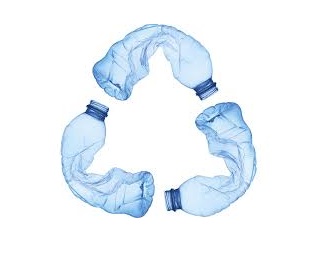
How can plastics be designed so that they maintain their useful properties while also being more easily recyclable? Chemist Stefan Mecking and his research group at the University of Konstanz are focused on studying eco-friendly solutions for plastics. In their recent paper in the international edition of Angewandte Chemie, the team introduces a new polyester that exhibits material properties that are suitable for industrial use and environmentally responsible.

Normally Hardly Compatible

Plastics are made of long chains of one or several chemical basic modules, so-called monomers. Plastics distinguished by high crystallinity and water repellency, therefore mechanically highly resilient and stable, are widely used. A well-known example is high-density polyethylene (HDPE), whose basic modules consist of non-polar hydrocarbon molecules. What may on the one side be advantageous properties for applications can also have adverse effects: It is very energy intensive and inefficient to recycle such plastics and recover the basic modules. Also, if such plastics leak into the environment, the degradation process is extremely long.

To overcome this supposed incompatibility between the stability and biodegradability of plastics, Mecking and his team insert chemical “breaking points” in their materials. They already showed that this greatly improves the recyclability of polyethylene-like plastics. However, good biodegradability is not automatically guaranteed. “Plastics often gain high resilience because they are ordered in densely packed crystalline structures,” Mecking explains: “Crystallinity in combination with water repellency usually strongly decelerates the biodegradation process, as it impairs the microorganisms‘ access to the breaking points.” However, this does not apply to the researchers’ new plastic.

Crystalline and Yet Compostable

The new plastic, polyester-2,18, consists of two basic modules: a short diol unit with two carbon atoms and a dicarboxylic acid with 18 carbon atoms. Both modules can be easily obtained from sustainable sources. For example, the starting material for the dicarboxylic acid, which is the plastic’s main component, comes from a renewable source. The polyester’s properties resemble those of HDPE: due to its crystalline structure, for example, it exhibits both mechanical stability and temperature resistance. At the same time, the first experiments for recyclability showed that under comparatively mild conditions, this material’s basic modules can be recovered.

The new plastic also has another, quite unexpected property: in spite of its high crystallinity it is biodegradable, as lab experiments with natural enzymes and tests at an industrial composting plant showed. Within a few days, in a lab experiment, the polyester was degraded by enzymes. The composting plant’s microorganisms required about two months, so this plastic even meets ISO-composting standards. “We too were amazed by this rapid degradation,” says Mecking, who adds: “Of course, we cannot transfer the results of the composting plant one-to-one into any conceivable environmental condition. But they do confirm that this material is indeed biodegradable and indicate that it is much less persistent than plastics like HDPE, if it should unintentionally be released into the environment.

”Both the recyclability of this polyester and its biodegradability under variable environmental conditions are now to be studied further. Mecking sees possible applications for this new material, e.g. in 3D printing or in the production of packing foils. In addition, there are further areas of interest, in which it is desirable to combine crystallinity with recyclability and the degradation of abraded particles or similar loss of material.

https://scitechdaily.com/

#scitechdaily #SustainablePlastics #BiodegradableMaterials #PlasticInnovation #EcoFriendlySolutions#CompostablePlastics#modernplasticsindia #modernplasticsasia  #plasticsislife #plasticstalk  #modernplastics#plasticsisgood #plasticsplane#plasticsrecycling#plasticmagazine  #plasticIndustry#modernplasticsmiddleeast #indianmagazine#innovations #modernplasticsamerica #modernplasticsbangladesh #modernplasticsasia#modernplasticsitaly

Dutch Recycler Stiphout Plastics Files For Bankruptcy

0

Dutch Recycler Stiphout Plastics Files For Bankruptcy

LyondellBasell had a 50% stake in the company Stiphout Plastics, a plastics recycler based in the Netherlands, filed for bankruptcy in mid-December 2024.

The Montfort based mechanical recycler started operations in 2013 and, as of 2023, had a recycling capacity of 18,000 tonnes of plastic waste per year. The facility consisted of three recycling lines specialised in HDPE and PP household waste processing. It employed around 30 workers.

Stiphout Plastics is one of six Dutch plastics recyclers to close doors in 2024. Low recyclate prices, pushed lower by cheap imports, drove the company to breaking point, the company’s founder Eline Stiphout told Dutch press outlets.

In July 2023, LyondellBasell (LYB) had acquired a 50% stake in Stiphout Industries, the parent company of Stiphout Plastics.

Asked to comment on the bankruptcy, LYB said it was ‘disappointed by the current news’.

“LYB has learnt that Stiphout Plastics B.V. has filed for bankruptcy. In July 2023, LYB announced the acquisition of a 50% stake in Stiphout Industries B.V., the parent company of Stiphout Plastics B.V. This investment was aligned with our strategy to invest in recycling and plastic waste processing companies, and we are disappointed by the current news. Ending plastic waste and building a circular economy is one of the key pillars of LYB’s sustainability approach,” LYB told Sustainable Plastics.

Stiphout Plastics joins Blue Cycle, Vinylrecycling, Ioniqa, and Umincorp, amongst others, in filing for bankruptcy in the Netherlands.

As the plastics recycling industry moves into the fourth year of a low price environment, industry bodies continue to warn that crumbling EU competitiveness jeopardises the circular plastics transition.

https://www.sustainableplastics.com

#sustainableplastics#circulareconomy #plasticsrecycling #sustainability #dutchrecycling #wastemanagement#modernplasticsindia #modernplasticsasia #plasticsislife #plasticstalk  #modernplastics #pasticsnews #plasticsisgood #plasticsplane#plasticsrecycling#plasticmagazine  #plasticIndustry#modernplasticsmiddleeast#indianmagazine#innovations #modernplasticsamerica #modernplasticsbangladesh #modernplasticsasia#modernplasticsitaly

Andrea Grandi is the New General Manager of the SACMI Group

0

Andrea Grandi is the New General Manager of the SACMI Group

He succeeds Mauro Fenzi, whose tenure ended on 31st December 2024. A 49-year-old electronics engineer, Mr. Grandi has been with SACMI almost 25 years. During that time he has displayed outstanding technical and managerial skills, most notably in mechatronics and industrial automation

Imola, 2nd January 2025 – On 1st January, Andrea Grandi took on the role of SACMI Group General Manager. He succeeds Mauro Fenzi, whose mandate ended on 31st December 2024.

Andrea Grandi – a 49-year-old electronics engineer – joined SACMI in 2001. In a career spanning almost 25 years, he has held increasingly prominent roles within the Group and distinguished himself for his technical and managerial expertise in the fields of mechatronics and industrial automation.

His first 18 years were spent in the Special Pressing Business Unit and as the Metals PU Manager. In 2020 he became General Manager of the Advanced Technologies BU. Over the last three years he has held the key roles of Operations and Plant Director and, subsequently, Corporate Product Supply Manager, demonstrating a talent for operational management and innovation development.

In addition to his positions at SACMI, Andrea Grandi is a member of the Forming Committee of UCIMU (Association of Italian Machine Tool, Robot and Automation Manufacturers). He was also formerly on the Technical Committee of AIM, the Italian Metallurgy Association.

“His appointment”, underlines the President of SACMI, Paolo Mongardi, “aims to make the most of internal skills and strengthen our technological leadership across the various businesses, all within a framework of strategic and operational continuity. I take this opportunity to wish Mr. Grandi every success in this exciting new challenge. His experience and skillset offer a secure base from which to launch the SACMI Group towards new goals, ever-greater innovation and sustainable growth”.

The SACMI Board of Directors wish to express their heartfelt thanks to Mauro Fenzi for his dedication and the results achieved. “During his tenure at the helm of the Group, Mauro Fenzi displayed outstanding leadership and strategic vision: his work has seen the SACMI Group achieve success in terms of growth, technological and organizational innovation, and reputation on international markets”.

www.sacmi.com

#sacmi #andreagrandi #leadershipchange #industrialautomation  #technologicalInnovation #mechatronics#sustainability#corporateleadership #modernplasticsindia #modernplasticsasia #plasticsislife #plasticstalk        #modernplastics#pasticsnews #plasticsisgood #plasticsplane#plasticsrecycling #plasticmagazine#plasticIndustry#modernplasticsmiddleeast#indianmagazine #innovations #modernplasticsamerica #modernplasticsbangladesh #modernplasticsasia#modernplasticsitaly

Nu-Vu Conair Expands Horizons with Facility Expansion.

Nu-Vu Conair Expands Horizons with Facility Expansion.

It is with great joy that we announce the inauguration of our new manufacturing facility on 3rd December 2024, in the presence of senior representatives from Piovan Group, PGNA, and NVC. Located adjacent to our existing facility, this expansion is a testament to Nu-Vu Conair’s continued growth and commitment to delivering excellence to our customers.

Spanning an impressive 60,332 sq. ft., the new facility is strategically designed to enhance our production capacity, enabling us to meet the increasing customer demand with greater efficiency by implementing LEAN principles that help in delivering equipment of highest quality with shortest lead time. This facility also includes a product development centre that will aid us in introducing new technologies to our customers. As we expand, we continue to focus on operational excellence and innovation, ensuring that we maintain the highest standards in the plastic auxiliary equipment industry.

At Nu-Vu Conair, we have been pioneers in providing cutting-edge solutions to plastic processors for over two decades. This expansion is a natural progression; highlighting our unwavering commitment to quality, reliability, sustainability, and customer satisfaction that has earned us a trusted reputation in the industry.

Nu-Vu Conair Pvt. Ltd. is a joint venture between Nu-Vu Engineers, Ahmedabad, India and The Conair Group, Pennsylvania, USA. Conair Group is now part of Piovan Group (Italy) which is the world’s largest auxiliary equipment manufacturer; a network that includes 13 brands, over 1,800 employees, and 14 facilities across the globe.

This milestone is an exciting chapter in our journey, and we extend our heartfelt gratitude to all our stakeholders who have supported us along the way. With advanced technology, streamlined operations, and a dedicated workforce, we are poised to set new benchmarks in the industry.

At Nu-Vu Conair, we are excited for the future and look forward to continuing to exceed expectations as we lead the way in plastic auxiliary equipment manufacturing.

https://www.conairgroup.com/

#conairgroup#modernplasticsindia #modernplasticsasia #plasticsislife

#plasticstalk #modernplastics #modernplasticsworld #plasticsnews

#plasticsisgood #plasticsplanet #plasticsrecycling


QC20 Ballbar For Machine Tool Verification

0


QC20 Ballbar For Machine Tool Verification

Highly regarded within the industry for being quick, simple and effective, Renishaw’s ballbar for machine tool performance verification, is the trusted choice.

Meeting stricter tolerances, keeping up with customer deadlines, and maintaining international quality standards does not have to be a complex or ambitious objective. Incorporating straightforward measures such as machine calibration can effectively streamline processes, enhancing precision and efficiency along the way. Our QC20 ballbar is leading the way in machine tool diagnostics.

What is a ballbar?

A ballbar is a telescoping linear sensor equipped with precision balls at both ends. Our QC20 ballbar serves as a precision measurement device used to assess a machine tool’s performance by detecting minute variations in radius as it follows a programmed circular path around a fixed mount. During operation, the sensor’s balls are precisely located within magnetic cups, facilitating the measurement of radius.

Why would you use a ballbar?

Component dimensional and finish defects can stem from various factors, including defective tooling, worn spindles, or issues with workpiece clamping. However, defects can also trace back to positioning errors within the machine tool itself. These errors are known as geometric, dynamic or play-related issues.

Errors can be promptly addressed, often within a matter of minutes, provided you can pinpoint their exact nature and location. Whether your machine is brand new or used, errors can occur.

The key to achieving defect-free production lies in understanding the true capabilities of your machine. This knowledge enables you to effectively plan production and make necessary adjustments where required.

Historically, achieving this understanding involved machining test or “master” parts, followed by meticulous inspection. Not only is this method time-consuming but it also offers limited confidence when dealing with parts featuring different geometries than the master part.

With QC20 ballbar testing you can effectively assess a machine tool’s performance. Areas where remedial action may be necessary can be identified quickly, providing you with the insights needed to maintain high-quality production.

Performing a ballbar test

Ballbar testing involves a straightforward three-step process:

  • QC20 ballbar set-up
  • data capture during testing (360° or 220° partial arc)
  • data analysis and diagnosis.

Featuring the latest Bluetooth Low Energy (BLE) technology, the QC20 ballbar rapidly forms a robust wireless connection with the PC and provides superior power efficiency, plus a substantially longer battery life when in use.

Read ballbar testing explained to explore the range of tests that can be carried out with the QC20 ballbar. Our QC20 ballbar accessories for machine applications further enhance its versatility.

Ballbar 20 software

Our powerful diagnostics software simplifies testing and reporting processes for machine tool preventative maintenance measurement using the industry standard QC20 ballbar.

  • Comprehensive test and reporting; flexibility to display captured data as analysis reports to international standards, e.g. ISO 230-4, ANSI B5.54 or using the comprehensive Renishaw analysis format.
  • Selectable user modes; adapts to suit the operator’s needs, skill level and authorisation (Quick Check, Operator and Advanced).
  • Part program generator; helps ballbar test CNC part programs to be automatically generated quickly.
  • Machine performance history; review variations in the machine’s performance over time using standard report graphs and plot points for in-depth explorations.
  • Ballbar plot simulator; powerful tool to aid decisions on corrective action or maintenance predictions from test results.

Meeting international standards

Recognised in major international standards, a ballbar test can serve as a crucial component of overall quality assurance procedures within a manufacturing process and as an objective assessment tool for the CNC machine tool.

Using QC20 ballbar for ISO 10791-6 standard testing is achieveable and highly effective. The QC20 ballbar can efficiently complete most tests outlined in the ISO 10791-6 standard. Reporting the maximum to minimum deviation in accordance with ISO 10791-6 can be effortlessly achieved by capturing data using our Ballbar Trace software.

https://www.renishaw.com/

#renishaw#modernplasticsindia #modernplasticsasia #plasticsislife #plasticstalk #modernplastics#modernplasticsworld #pasticsnews #plasticsisgood #plasticsplane#plasticsrecycling#plasticmagazine #plasticIndustry#modernplasticsmiddleeast#indianmagazine#innovations #modernplasticsamerica #modernplasticsbangladesh #modernplasticsasia #modernplasticsitaly

Labotek Compressed Air Dryer Drying Of Plastic Materials

Labotek Compressed Air Dryer Drying Of Plastic Materials

LCD- Series

The Labotek Compressed Air Dryer LCD is a high-quality, energy-efficient solution for removing moisture from plastic raw materials, achieving a dew point as low as -45°C. Its compact design, user-friendly controls, and advanced safety features make it ideal for industries like automotive and electrical components. With real-time monitoring of temperature, pressure, and dew point, it ensures optimal drying while reducing energy consumption and operating costs. Its space-saving design allows for easy installation and integration into existing systems.

LCD-Series Features: 

  • Compact, space-saving design
  • Lid compatible with SVR/Mini-Feed loaders
  • Microprocessor-based control with LCD display
  • Continuous compressed air flow modulation
  • Daily/weekly timer & solid-state relay control
  • Anti-stress system with visual & acoustic alarms
  • Compressed air filter & Android app support
  • Models: LCD5, LCD15, LCD30
  • 3-year warranty (excludes wear parts)

 Labotek India’s LCD Dryer, is produced in Stainless Steel.

The Labotek LCD Dryer,  constructed with stainless steel (SS). For enhanced durability and corrosion resistance. This features a user-friendly control panel for easy operation and precise monitoring of the drying process.

Key highlight: Advanced control through Android application.


https://www.labotek.in/

#labotek#modernplasticsindia #modernplasticsasia #plasticsislife

#plasticstalk #modernplastics #modernplasticsworld#plasticsnews

#plasticsisgood#plasticsplanet#plasticsrecycling


Alignment Lasers For Machine Build

0

Alignment Lasers For Machine Build

Renishaw’s XK10 alignment laser provides a single digital solution for measuring and adjusting geometric and rotational errors during machine build. This reduces the machine assembly time and optimizes overall performance.

What is an alignment laser?

An alignment laser is a precision tool that utilizes lasers to accurately align components during build and service of industrial machines such as machine tools, precision stages and semiconductor manufacturing machines. Designed to optimize performance, alignment lasers facilitate high-accuracy measurement, digital reporting and real-time axis adjustments.

The increasing demand for intuitive tools to streamline machine alignment processes has outpaced the effectiveness of many traditional methods.

The XK10 alignment laser offers digital precision for aligning both linear and rotary axes, presenting a modern upgrade from traditional manual methods. This leads to a significant reduction in machine build, maintenance and service time.

Why would you use an alignment laser?

It is crucial to ensure precision during construction of a machine tool to make sure that it is reliable and efficient. Checking the alignment during the build process can prevent errors from being discovered after the machine has been built, which can be more difficult to fix. Regular alignment checks are also valuable during on-site service, maintenance or following a collision.

The XK10 alignment laser provides a quick, easy and versatile alternative to traditional methods, like dial gauges, autocollimators and metrology artefacts. It eliminates the need for time-consuming procedures. It can be used to ensure that linear rails are straight, square, flat, parallel and level. It can also assess spindle direction and coaxiality of rotary machines.

The XK10 display unit digitally records measurements, providing comprehensive error reports and reduces operator error due to manual documentation.

System overview

The XK10 launch is the primary laser source for most types of measurement. It is used with the M unit for geometric measurements up to 30 m. The S unit and M unit contain both transmitters and receivers which can be configured in different ways based on the measurement set-up.

The XK10’s machine tool fixturing kit is designed to improve repeatability and accuracy in measurements. Measurements are taken and recorded with the XK10 display unit. This allows up to 30 hours of portable operation with the rechargeable battery.

The straightness and parallelism analysis feature in CARTO Explore creates custom reports. This provides reliable results for checking and correcting machine alignment.

Renishaw can provide calibration training from experienced engineers to ensure optimal product performance.

Key features

  • Flexibility – multiple measurements for different machine configurations from a single kit.
  • Automatic analysis – immediate measurement results, with live displays for adjustment and easy export to .xml file or CARTO.
  • Intuitive software – guides you through the set-up and measurement process, quickly and easily. Visit calibration software downloads for the latest version.
  • Wireless connectivity – ensures flexibility within the set up and measurement.
  • Easy fixturing – designed for repeatable, accurate results and reduces set-up time.
  • Rotating head – allows easy beam pointing from the launch unit with the capability to measure flatness using a series of grid points.

XK parallelism kit

The XK parallelism kit is an additional accessory required to carry out parallelism measurements. It allows two nominally parallel straightness measurements to be carried out without moving the launch.

Accurate – 90° deflection of the laser beam. Versatile adjustments allow ease of alignment.

An optional tripod mount kit is available for use with a tripod when there is no space to directly mount the launch.

Straightness measurement

Measure vertical and horizontal straightness along an axis with the XK10 alignment laser system.

Used during the machine build process to ensure accuracy when mounting and aligning stages and guideways.

Spindle direction measurement

XK10 measures the angle at which a spindle or chuck is pointing.

This can be used for any spindle or chuck alignment, to ensure that it points in the same direction through a full 360° rotation.

https://www.renishaw.com/

#renishaw#modernplasticsindia #modernplasticsasia #plasticsislife #plasticstalk #modernplastics#modernplasticsworld #pasticsnews #plasticsisgood #plasticsplane#plasticsrecycling#plasticmagazine #plasticIndustry#modernplasticsmiddleeast#indianmagazine#innovations #modernplasticsamerica #modernplasticsbangladesh #modernplasticsasia #modernplasticsitaly

Monique Buch Appointed As New Chief Commercial Officer Of Covestro

0

Monique Buch Appointed As New Chief Commercial Officer Of Covestro   

Covestro, a world-leading supplier of high-tech polymer materials, is announcing Monique Buch (50) as the company’s new Chief Commercial Officer (CCO). The Supervisory Board of Covestro has unanimously appointed Monique Buch who is taking over from Sucheta Govil by 1st June 2025. Sucheta Govil’s as been Covestro’s CCO since 2019. Her two consecutive terms with Covestro come to an end by 31st July 2025.

As the Chief Commercial Officer, Buch will be responsible for the segment of Solutions & Specialties. With this, she will be leading six business entities including the supply chain centers in the three major regions.

Dr. Richard Pott, Chairman of the Supervisory Board of Covestro said: “Monique Buch is an experienced B2B commercial executive with a strong international footprint. With her background in building sustainable, market-leading businesses she will be an ideal successor to Sucheta Govil in the Board of Management and will continue to shape the future of Covestro. Already now, we want to express our deep gratitude to Sucheta Govil who has laid the solid foundation for a successful development in commercial excellence and innovation. With her strong background in commercial operations, sales, marketing, and innovation, she has been and will be steering the transformation journey of Covestro.”

“I am very much looking forward to join the transformation journey by driving profitable growth, along with the whole Covestro team and my new colleagues on the Managing Board,” said Monique Buch.

Dedicated to sustainable growth

Monique Buch was born in the Netherlands and studied industrial engineering and management. In her last position, Buch was Executive Vice President Nonwoven at Lenzing AG. Before, she held various executive positions in international B2B companies, among them Freudenberg Performance Materials and Owens Corning.

www.covestro.com.