Artificial Intelligence Helps Shape Change in the Chemical Industry
The industry is discovering more and more possibilities for the use of artificial intelligence (AI). However, when implementing and using AI in the chemical industry, many peers also face similar challenges that still need to be solved. For this reason, Covestro, Evonik and Accenture invited managers from production and technology divisions of Bayer, Clariant, Wacker, Shell, Lanxess and other companies to a two-day Chemicals Peer Exchange for the fourth time “For me, the chemical industry is predestined for the use of AI because we have a lot
of complex processes going on that cannot be described by fixed rules,”says Walter Grüner, Head of IT & Digitalization at Covestro. “They are not suitable for automation. We rather need learning systems to which we grant a certain degree of decision-making autonomy. In doing so, we focus primarily on the development of systems that work in a complementary manner to humans and support their abilities.”
With the introduction of AI in the chemical industry, questions about technical, operational and organizational implementation are also increasingly emerging. This includes, for example, the role of AI in decision-making, but also its implementation along value chains.
Artificial Intelligence – great opportunity for the chemical industry
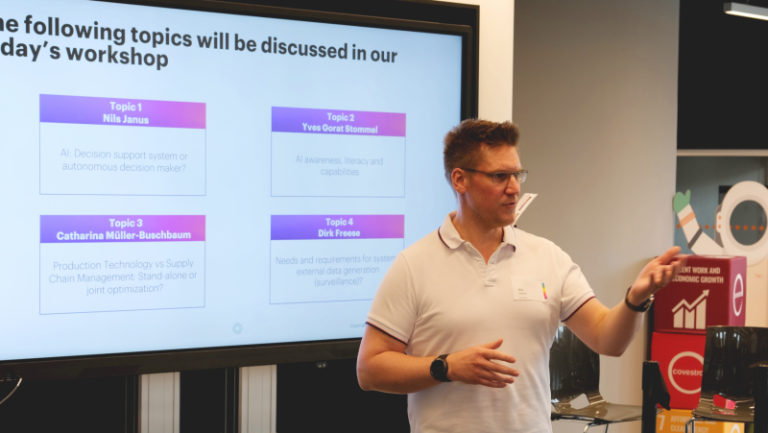
Under the motto “Shaping industrial change with AI”, the participants exchanged in a generic way views on the following topics:
AI system to assist decision making or as an autonomous decision-maker?
AI awareness, literacy and capabilities
Production technology vs. supply chain management: independent or joint optimization?
Needs and requirements for external data generation (monitoring)?
“It is precisely the exchange across company boundaries that helps us a lot in the upcoming transformation because overall challenges become clearer,” says Nils Janus, Global Head of Advanced Analytics at Covestro. “This increases efficiency and saves time.”
Overall, there was agreement among the participants: Artificial intelligence offers great opportunities for the chemical industry. The new systems help to create a common ecosystem for cross-divisional production planning. It must be decided on a case-by-case basis and each company has to decide individually and independently how much autonomy these systems will be given. With regard to access to the systems, the participants saw a strong democratization of artificial intelligence. Companies could support employees in learning more about data and AI and bring them into contact with experts when it comes to the widespread use of AI solutions in the company. The generation and dissemination of ESG (Environmental, Social and Governance) data is currently the biggest driver for using external data sources. Here, all participants saw opportunities to intensify the use of external sources.
Digitalization drives sustainability
Digitalization is a key driver to improve sustainability and make the circular economy a reality. Covestro is focusing on more data-oriented corporate governance to drive digital transformation.
Covestro is advancing the use of artificial intelligence (AI) both in its own company and in the chemical industry. To this end, the materials manufacturer is investigating how digital technologies can make processes more efficient and sustainable as part of several pilot projects across different divisions.
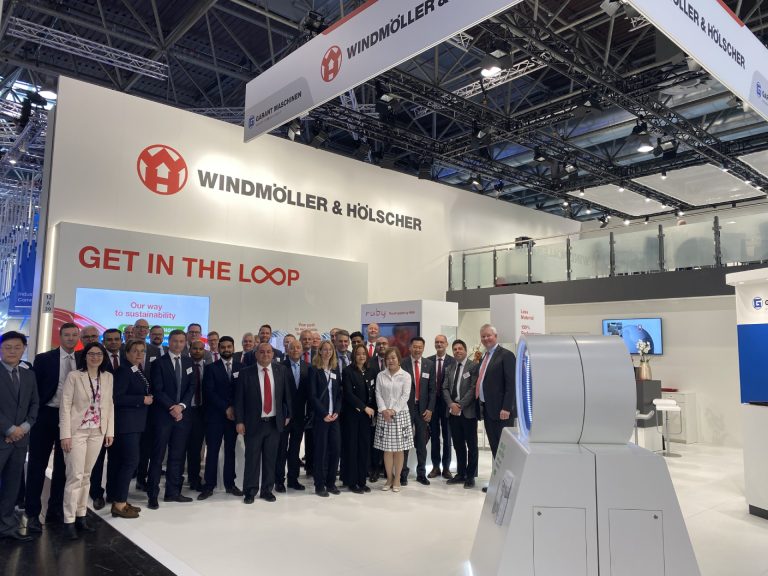
Windmöller & Hölscher Satisfied With Interpack 2023
The interpack 2023 was the first trade fair of the packaging industry in Europe completely without travel restrictions. The Lengerich-based machine builder Windmöller & Hölscher draws a positive balance: The change in the packaging industry increases the demand for innovative machines. This offers market opportunities for the technology leader W&H. Sustainability was the biggest driver, combined with digitalization and the continuing drive for efficiency.
The interpack trade fair, which took place from May 4 to 10, 2023, is one of the largest trade fairs for the packaging industry and attracts thousands of visitors from all over the world every year. W&H was represented at the booth by employees from all over the world, 18 nationalities in total, just like before pandemic times. “At interpack, our global customers, packaging manufacturers and packaging printers, exhibit their latest products. In addition to product presentations, personal meetings are an important element of interpack for us,” says Dr. Sascha Witt, Chief Sales Officer. For the Asian region, it was the industry’s first European trade show without travel restrictions.
The themes of interpack show the future of the packaging industry. “Sustainability is a topic in every customer conversation,” says W&H CEO Peter Steinbeck. But digitization and efficiency are also driving the industry further. “The three topics intertwine, for example, digitalization enables a new transparency, which is the basis for more sustainability,” explains the CEO. “In addition to machines, we again presented examples of recyclable packaging solutions that can be produced with our technologies,” says Witt.
Subsidiary GARANT Maschinen, a specialist in paper packaging, was also represented at the booth. One highlight presented: a new machine for the production of paper packaging for hygiene articles, for example outer packaging for diapers.
“There is also a very high demand for machines for paper shipping bags, for example for online orders,” says GARANT Managing Director Torsten Berding.
W&H subsidiary GARANT is exhibiting new machines for paper packaging, e.g. for diapers, at the interpack.
Borealis and IINO Lines Sign Long-Term Charter Contract for the Oceanus Aurora, a Custom-Built State of Art LPG Vessel
New liquefied petroleum gas (LPG) dual-fuel vessel is equipped with emission-lowering motor and propulsion systems
Long-term charter improves cost competitiveness of transatlantic feedstock shipments
Agreement moves Borealis closer to realizing energy and climate targets in its Base Chemicals business areas and to achieving IINO’s 2050 carbon neutrality realization.
Borealis, one of the world’s leading providers of advanced and sustainable polyolefins solutions, and IINO Kaiun Kaisha, Ltd. (IINO Lines), a global leader in maritime transportation headquartered in Japan, announce the long-term charter of a custom-built vessel, the Oceanus Aurora. The vessel was ordered from IINO Lines in 2021 and delivered to Borealis 14 May 2023.
With a cargo tank capacity of 91,000 m3, largest VLGC (Very Large Gas Carrier) vessel in its class, will transport feedstock – mainly propane and butane – from North America to Borealis crackers and propane dehydrogenation plants in Europe, including Kallo (Belgium), Stenungsund (Sweden), and Porvoo (Finland). As the second long-term charter signed by Borealis, the Oceanus Aurora supplements the charter signed with Navigator Gas for the Navigator Aurora, a dual-fuel MGC (Medium Gas Carrier) which has been transporting ethane to Stenungsund since 2016.
Thanks to its dual-fuel engine, the Oceanus Aurora can be powered by either liquefied petroleum gas (LPG) or low sulphur fuels. The vessel is equipped with a – Shaft Generator Motor system for electrical power generation from LPG dual fuel. This lowers both fuel consumption and emissions, with meaningful reductions in the most common air pollutants from ships, such as nitrogen oxides (NOx), sulphur oxides (SOx), carbon dioxide (CO2), and particulate matter.
The vessel’s environmental footprint is further improved thanks to the installation of an innovative wind propulsion system in the form of two Norsepower Rotorsails™. Developed by Norsepower Ltd., these sails are a modern adaption of the Flettner rotating cylinder and scheduled to be installed within 2nd quarter in 2024. By using modest amounts of electricity to set a deck cylinder in motion, these spinning cylinders, along with the wind, create a Magnus effect to generate thrust. By augmenting the main propulsion system, the sails thus reduce total fuel consumption, emissions, and operating costs.
“It is essential to capitalize on every opportunity to become even more independent and flexible when it comes to transporting cost-competitive feedstock from overseas to our base chemicals operations in Europe,” says Thomas Van De Velde, Borealis Senior Vice President Hydrocarbons & Energy. “As the second long-term charter for Borealis, the Oceanus Aurora is not only giving us the competitive flexibility, but is also helping us reduce the environmental impact of our own transportation operations in accordance with our strategic Energy & Climate ambitions. This is how we continue to re-invent essentials for more sustainable living.”
“At IINO Lines, we use our six decades of experience and know-how in transporting LPG to make shipping more environmentally sustainable,” says Ryuichi Osonoe, IINO Lines Senior Managing Executive Officer Management of Gas Carrier. “We are pleased to have found in Borealis a partner who shares our belief in the power of innovation to reduce environmental impact. This long-term charter is an auspicious start to what we trust will be a long and mutually beneficial partnership.”
KRAIBURG TPE’s Well-Rounded TPE Solutions for Anti-Slip Mats
KRAIBURG TPE’s material solutions meet automotive OEMs’ high-performance material and soft-touch surface requirements for automotive interior applications in Asia Pacific and around the world.
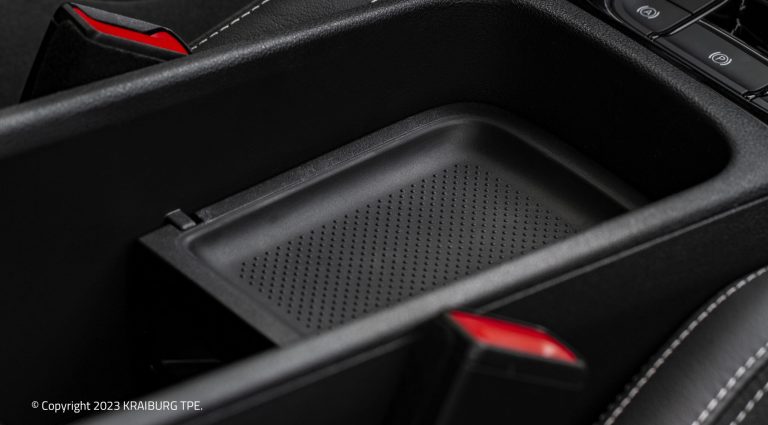
An anti-slip mat is an essential interior piece designed to keep objects such as cell phones, eyeglasses, keys, and other personal accessories in place on a car’s dashboard or other interior surfaces while driving, thereby preventing the driver from becoming distracted. Anti-slip mats with a soft-touch surface can also function as an attractive feature for the car’s interior.
These mats are frequently made of a soft, rubber-like substance, such as thermoplastic elastomers (TPEs), which provide good grip, friction, durability, flame and chemical resistance, and other suitable features.
KRAIBURG TPE, a global manufacturer of thermoplastic elastomer materials and bespoke solutions for a wide range of industries, provides high-quality TPE series of compounds for automotive interior applications.
THERMOLAST K FG/SF/AP series gains traction in the Asia Pacific market
KRAIBURG TPE’s THERMOLAST K FG/SF/AP series, made for the Asia Pacific market, provides high-performance material benefits to manufacturers that emphasize surface appearance and quality requirement in automobile interior design.
This series of compounds offers high flow properties, easy processing, and soft touch surface. Additionally, these compounds provide good surface mapping for processes that require complex molding designs for aesthetic reasons, and controlled emission and odor levels, making them suitable for anti-slip mat applications.
Other characteristics of the series include good adhesion to PP via the injection molding process, temperature stability up to 100°C, short processing cycle time and low density.
Furthermore, in-process recycling is a possibility for this series of compounds, meeting the automotive market’s sustainability standards.
Sustainability successes of our TPEs
Besides anti-slip mats applications, KRAIBURG TPE’s recent sustainability innovations include a specially developed material solution for consumer, and industry applications comprising post-consumer recycled (PCR) and post-industrial recycled (PIR) content.
Husky Commemorates Expansion in India With Ceremonies at Chennai Facilities
Husky Technologies, a pioneering technology provider enabling the delivery of essential needs to the global community, today commemorated the next phase of expansion to the company’s India facilities with ceremonies at their new offices and existing Chennai campus. The events were hosted by local leaders in the region, as well as senior executive, Robert Domodossola, President of Husky’s Rigid Packaging business.
“I am thrilled to return to India to mark this special occasion as we expand our presence in this exciting and dynamic market,” said Robert Domodossola, Husky’s President of Rigid Packaging. “This celebration reaffirms our commient to the strong relationships we’ve been building with our customers in this region since 1999. As we enter our 70th year in business, this invesent truly acknowledges the opportunities for growth and demand for Husky’s diverse range of complete solution offerings in India.”
These momentous celebrations kick off a robust expansion plan that will see a number of exciting developments executed throughout 2023, including:
Additional capacity and capability for manufacturing hot runners
The first ICHOR integrated medical injection molding system that produces blood collection tubes locally
The addition of an Advantage+Elite monitoring center to provide proactive, predictive and transparent monitoring services to our existing customers
Expansion of local OEM parts inventory and team of highly skilled service technicians situated throughout the country to respond to customer service needs swiftly and efficiently
“As we approach 25 years of serving customers in India, our goal is to continue developing and delivering the right mix of innovative technologies, solutions and services that enable all regional producers to meet current trends in increasingly responsive, adaptable and diverse ways,” said Wassim Labban, Husky’s Vice President of Rigid Packaging for EEMEIA, SEA and ANZ.
Since selling the first PET system into India in 1999, Husky’s presence has grown to include more than 250 systems running in the field, delivery of more than 500 hot runners per year, a team of trained service technicians and a robust parts inventory to support local customers.
To stay connected and continue to get updates on Husky’s India expansion progress, follow us on social media, or visit www.husky.co
Authentic Packaging – A Supplier of Rigid Plastic Packaging
As a supplier of rigid plastic packaging, we take pride in being at the forefront of innovation and sustainability in the industry. We understand that packaging plays a critical role in protecting and preserving products, while also being environmentally responsible. Our company is committed to creating packaging solutions that meet these requirements and exceed our customers’ expectations.
One of our key areas of focus is on reducing the environmental impact of our packaging. We believe that sustainability is not just a buzzword but an essential component of doing business in today’s world. We are constantly exploring new materials and manufacturing techniques that reduce waste and improve the recyclability of our products.
For example, we have developed packaging solutions that use post-consumer recycled (PCR) materials. These materials are derived from plastic waste, which is collected, sorted, and processed into new packaging products. By using PCR materials, we are reducing the amount of plastic that ends up in landfills or oceans while also conserving natural resources.
In addition, we are committed to reducing our carbon footprint by using energy-efficient manufacturing processes and renewable energy sources constantly. We have also implemented a closed-loop recycling program in our facilities, which allows us to recycle plastic waste generated during the manufacturing process.
Our company also takes great pride in our ability to offer custom packaging solutions that meet the specific needs of our customers. We work closely with our clients to understand their product requirements and create packaging solutions that are tailored to their needs. Our state-of-the-art manufacturing facilities and experienced team enable us to produce high-quality, customized packaging solutions that meet our customers’ expectations.
In conclusion, as a supplier of rigid plastic packaging, we understand the importance of creating sustainable and innovative solutions that meet the needs of our customers while also protecting the environment. We are committed to pushing the boundaries of packaging technology to create solutions that are not only functional but also environmentally responsible.
Lower carbon footprint thanks to bio-based material
Supports freshness, quality, and shelf life of food
Reduces waste by enabling recyclable packaging
The world of packaging is changing quickly. Legislators, food brands, and society at large are all demanding packaging that is less wasteful. At the same time, consumers don’t want to compromise on food safety and convenience.
The latest innovation from Covestro provides a solution to meet these growing needs: a partially bio-based barrier coating resin, Decovery CQ 6010, which helps ‘close the loop’ for recyclable paper packaging.
Reducing waste by replacing PE and aluminum layers
Many packaged food products are sensitive to moisture, so controlling the moisture vapor transmission rate (MVTR) is critical to maintaining the quality of the food. To protect the product inside a package, paper and board food packaging is often laminated with polyethylene (PE) or aluminum. These materials limit the packaging’s recyclability, meaning it often ends up going to landfill or being incinerated. Covestro’s innovative barrier coating resin reduces waste by replacing these PE or aluminum layers in paper food packaging to make it recyclable.
By enabling low MVTR values, Decovery CQ 6010 provides a moisture barrier to protect the food, as well as delivering good oil and grease resistance. This makes it suitable for use in packaging for a wide range of food, from dry high-fat products such as chocolate bars to ice cream, frozen food, and fresh fruit. The resin is made with 37 percent plant-based and transparently sourced ingredients, such as bark, castor beans, and corn. This substantially reduces its carbon footprint in comparison to virgin PE and standard fossil-based coatings.
Davide Reverdito Bove, Sector Marketing Manager Printing & Packaging at Covestro: “While PE laminates do a good job of protecting food contents, they make food packaging virtually impossible to recycle. As a result, a lot of them go to landfill or are incinerated. Our new resin is a game-changer in addressing this issue. It gives food producers and packaging makers an excellent opportunity to deliver the protection that packaging requires while having less impact on the environment. That’s just one reason why we are so proud of this new coating, and so excited to be telling the world about it.”
High-Accuracy Accelerometers Provide a Simplified Road Load Assessment Method
Vehicle tests can be time-consuming and expensive on account of the large number of sensors required for comprehensive measurement data acquisition. The Kempten-based monitoring specialist, monalysis, has therefore developed a method that allows these tests to be carried out far more cost-effectively than before. The durability transfer process is based on high precision accelerometers from ASC and is used by MAN Truck & Bus SE among others.
The preparation and execution of a vehicle test, with a fully equipped test vehicle, is very complex. The application, calibration and setup of various measuring points alone usually takes several weeks. “The costs of this sensor work also include the investments in sensors and the measurement data acquisition, as well as personnel costs for the permanent technical support of the measurement campaigns,” says Benedikt Mundl, to explain the expenditure involved.
At monalysis, Benedikt Mundl is responsible for the test drives and he travels around the world to this end. The tests generate meaningful data to provide manufacturers with important information about the load behavior of their vehicles. “This kind of acquisition of load data from a large number of vehicles in actual customer operation would be desirable from the point of view of vehicle developers, but the high costs involved tend to make it unfeasible”, explains Michael Städele, General Manager of monalysis GmbH.
Monalysis carries out extensive test drives with the MAN trucks, which are also driven over rough terrain and through mountain passes.
Tests allow trucks to be adapted to regional road conditions
The requirements for robustness vary greatly from country to country and depend on the conditions of use in any given region. “Different load situations apply to motorway journeys than when driving on an unpaved mountain pass”, says Benedikt Mundl. The aim of the monalysis studies is therefore to identify as easily as possible the various regional and use-dependent loads and stresses on a wide range of vehicles, so that MAN can take the lessons learned into account in the development of its trucks.
New procedure reduces burden and costs
Monalysis is a spin-off from the Kempten University of Applied Sciences in Allgäu, Germany, and since its founding in 2011 has already carried out numerous vehicle tests with MAN. In order to reduce the burden and costs of vehicle testing, the analysis experts developed an innovative measurement method. The “durability transfer method” makes it possible to drastically reduce the number of sensors from several hundred to just a few, for measuring, for example, acceleration on the chassis or body longitudinally, laterally and vertically. From these relevant indicators, the load and stress behavior can be derived in different vehicle areas using deep learning algorithms. “From the accelerator values recorded we can therefore draw conclusions about the load behavior on the whole vehicle or on individual components such as chassis, frame, components or the cab”, explains Michael Städele. Due to the significant reduction in the number of measurement points and independent measurement data collection, any customer vehicle may be used as a test vehicle in the future.
One of the places the ASC accelerometers are installed is on the truck chassis.
In addition, the durability transfer method can also be used to assess and categorize the road quality. If vertical vehicle accelerations are recorded, they may be used to assess the road quality of a particular road segment.
In order to obtain meaningful measurements, the sensors used must be extremely reliable. “We tested models from different manufacturers intensively before opting for the ASC accelerometers,” recalls Benedikt Mundl. “In addition to the high quality and excellent value for money, also decisive for us were the recommendations of companies that have already used ASC sensors and have been very satisfied with their performance.”
ASC sensors meet the high requirements of the test engineers
For the test drives on MAN trucks, monalysis uses 5521MF (Medium Frequency) triaxial capacitive accelerometers from ASC. They cover measurement ranges from ±2 to ±200 g and have a wide frequency response of 0 Hz to 7 kHz (typically ±3 dB). This makes the sensors particularly suitable for measuring low and medium frequencies. Due to its robust design, the ASC 5521MF also has a high resistance to repeated impact loads up to 6000 g and can operate with high accuracy and reliability at temperatures of up to +125°C.
Individual solutions can also be developed on request
Due to their wide frequency response and excellent impact resistance, the ASC accelerometers are used by many automotive industry companies for fatigue strength testing. This includes vibration tests, shock tests and test-to-fail investigations for material cost optimization.
Through many years of collaboration with the key international players in the automotive industry, the ASC sensor specialists know exactly what their requirements are. At ASC a wide range of sensor solutions have been developed to enable test and measurement engineers to perform their demanding tests under optimum conditions. The accelerometers are not only ideal for strength tests but are also very well suited for test bench applications, modal analyses, driving comfort measurements and crash and driving dynamics tests.
The sensors are used, among other things, to detect the acceleration on the truck wheel mounts.
In addition to capacitive analog accelerometers, ASC also manufactures digital accelerometers, yaw rate sensors, tilt sensors and inertial measurement units (IMUs). Since most customers require sensors for very highly specialized applications, ASC often develops bespoke solutions. This extends from the adaptation of individual components such as cables or connectors to modifications of existing sensors. In addition, the sensor specialist is developing and manufacturing more and more digital sensor solutions, so that it is also able to offer suitable solutions for future innovative applications.
High-quality “Made in Germany” sensors
All ASC sensors are developed, manufactured and calibrated at the Pfaffenhofen headquarters. As a result, the paths between development department, production and laboratory are very short. With many of its competitors, by contrast, only the development department remains in Germany, with production mostly taking place in Asia. Development and manufacturing in Germany not only give ASC the advantage of maintaining complete control over all processes and guaranteeing high product quality, but also mean that it can offer a comprehensive range of services. For example, ASC can recalibrate sensors (as per DIN EN ISO/IEC 17025:2005), as they must be regularly “re-adjusted”. Customers can also return defective sensors for repair.
Further test operations planned
Benedikt Mundl is very satisfied with the sensors and the service of ASC. The engineer will therefore soon be using the sensors on other vehicles, too. This will provide further insight into vehicle load and stress behavior worldwide, and into the quality of the roads.
Since the truck test drives are also carried out on unpaved roads, the sensors must be extremely robust
MedAccred Program Joins Influential Irradiation Industry Association
The MedAccred program has become a member of The Irradiation Panel, a renowned not-for-profit industry association representing global and diverse interests in radiation processing.
The panel is comprised of suppliers and users of irradiated products and irradiation services, regulatory bodies, and consultants. Membership currently consists of 46 companies and nine individual members, including Steris, Sterigenics, BD, Smith & Nephew, NPL, Nelson, IBA, Mevex, and Astra Zeneca.
Established in 1966 and based in the UK, it has members from across Europe and beyond, and provides a forum for discussing the advancement, development, promotion, regulation and practice of radiation processing using electron beam, gamma, and X-ray technology. The panel meets twice a year to discuss the major issues and challenges facing the industry.
Kim Patton, Sterilization Staff Engineer and Auditor, the MedAccred program, said:
“MedAccred is proud to have been accepted onto The Irradiation Panel. As the MedAccred programn representative, I will attend meetings, both virtual and face-to-face as we develop white papers, gather literature references, perform studies and commission publications.
“I am especially looking forward to working with industry radiation experts to create guidance documents to help the medical device industry address quality and compliance within critical process manufacturing.”
Holz-Bauer and Mondi Introduce PelletBag: Replacing Plastic With Paper
Holz-Bauer and Mondi launch new paper packaging PelletBags for wooden pellets
Use of high strength bags means Holz-Bauer now delivers its products in recyclable kraft paper made from renewable resources
New solution replaces previous plastic packaging alternative
Mondi, a global leader in sustainable packaging and paper, has created new paper bags for Holz-Bauer’s wooden pellets replacing unnecessary plastic.
Mondi’s PelletBags are created from 2-ply Mondi kraft paper which is produced, printed and converted in-house before being sent to Holz-Bauer for filling and closing, using its secure sewing method with a static binder machine. With PelletBag, Holz-Bauer will replace their existent plastic bag solution; currently an industry standard for wooden pellets. Holz-Bauer’s move to paper packaging is indicative of the trend towards using more sustainable packaging solutions.
Mondi and Holz-Bauer have complementary sustainability goals, that aim to contribute to a circular economy. Holz-Bauer’s wooden pellets are created from sawmill residue sourced from local businesses. Using sawmill residue in this way is in adherence to the principle of the cascading use of wood, which Mondi supports, and leverages the full value of fibre. This means that wood is used first for high performance products with hygiene or strengths requirements, such as kraft paper, and successively recycled until the residues are burned for green energy at the end of live.
Mondi’s kraft paper is created from renewable, responsibly sourced fibres and the final paper bag can be disposed of in existing European recycling streams. The bags have high tear resistance and can be stored and transported easily. Holz-Bauer’s 15kg PelletBags have an artisan design to reflect their own product and business identity.
Martin Bauer, Owner Holz Bauer, says: “Our whole company ethos is about providing natural products and keeping all materials that we use in the system as long as we can. By partnering with Mondi, we are working with a company that has the same goals – the team helped us create packaging that will be right for our products and our eco-conscious consumers.”
Fabio Barbieri, Sales Director Paper Bags, Mondi says: “We work along the approach of using paper where possible, plastic when useful – PelletBags provide the required strength and protection to pack wooden pellets. Using packaging from the same renewable resource as the contents themselves increases the brand value of the product, providing a sustainable and convenient solution for the end user.”
Mondi’s PelletBag is available in white and brown, and in a range of sizes up to 25kg, which were recently showcased at Expo Biomasa in Valladolid, Spain, from 09 to 11 May.